

How to choose the right transmission for your machine
When developing off-highway machines, choosing the right transmission is one of the most important decisions you’ll make.
It affects how the machine performs, how efficiently it uses fuel, how it feels to operate and how reliably it works over time. For OEMs developing backhoe loaders, telehandlers, site dumpers, the right transmission needs to do more than meet a specification; it needs to work as part of the complete machine.
That’s why we work side by side with OEMs to help them choose, tailor and validate the right transmission for their application. Our engineers and specialists support the process from early evaluation through to testing, production and long-term support.
What should you consider when choosing a transmission for an off-highway machine?
The best place to start is always with the machine itself.
Different machines have different demands. A backhoe loader, for example, will have different operating requirements to a telehandler, site dumper or rough terrain forklift. The terrain, duty cycle, load, speed requirements and working environment all influence the type of transmission needed.
Before recommending a solution, we need to understand what the machine is designed to do and how it will be used. This includes:
- Machine type and configuration
- Operating environment
- Typical duty cycle
- Load requirements
- Terrain and ground conditions
- Regional or legislative requirements
By starting with the application, rather than the transmission alone, OEMs can make better decisions from the beginning.
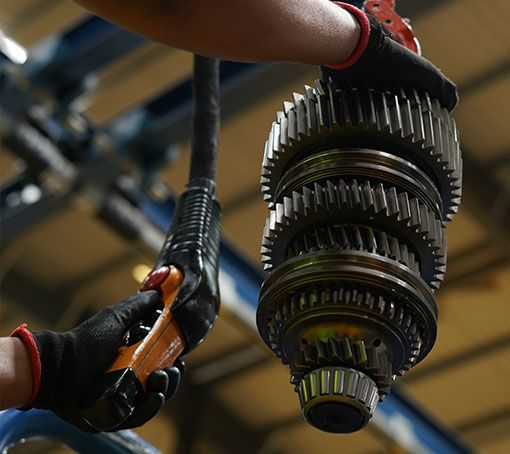
What information is needed to choose the right transmission?
To recommend the right transmission, it’s important to build a clear picture of the machine and its performance targets.
This typically includes:
- Machine weight
- Required operating speeds
- Torque and tractive effort requirements
- Gradeability targets
- Engine power curve
- Axle ratios
- Wheel and tyre sizes
- Driveline layout
- Typical duty cycles and operating conditions
This information allows us to carry out performance calculations and identify the most suitable transmission and gear ratios. The earlier this information is available, the easier it is to make informed decisions, reduce development risk and avoid compromises later in the project.
Why does transmission selection depend on the complete powertrain system?
A transmission does not work in isolation. It needs to integrate with the engine, axles, tyres and wider driveline.
Engine characteristics, mounting requirements, available space, torque converter compatibility and driveline layout can all influence the final recommendation. Integration also affects how the machine feels in use, including gear shifting, response, control and operator comfort.
By considering the full system early, OEMs can reduce the risk of integration issues and help ensure the final machine performs as expected in real-world conditions.
Which transmission type is right for your machine?
The right transmission type depends on the machine application, performance targets, operator requirements and market expectations.
Manual transmissions can be a good choice where control, durability and straightforward operation are key. They may also suit machines where cost and simplicity are important considerations. Turner’s synchro shuttle transmissions, including C90, Compact Plus and C115, are designed to support smooth shifting and dependable performance across off-highway applications.
Powershift transmissions may be more suitable where productivity, operator comfort and smooth gear changes are priorities, particularly for machines positioned around premium performance. Turner’s PG115 and PG145 powershift transmissions are built for demanding applications, with the PG145 designed specifically for telescopic handlers with an offset output design.
For machines with offset engine layouts, a bevel drive can support efficient 90-degree power transfer in compact designs. This gives OEMs more packaging flexibility and can help improve service access by enabling a better engine and transmission layout.
“A lower cost machine may suit a manual transmission, while powershift is often used for a more premium machine,” explains Alastair Mitchell, Product Manager, Drivetrain Systems at Turner. “The bevel drive gives customers packaging flexibility and more options for how the engine and transmission fit within the machine.”
The right choice depends on how the machine will be used, what performance is required and how the transmission needs to integrate with the wider machine system.
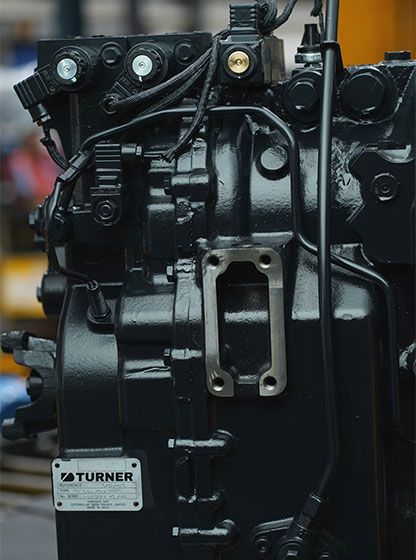
“A lower cost machine may suit a manual transmission, while powershift is often used for a more premium machine.”
Alastair Mitchell, Product Manager, Drivetrain Systems at Turner.
How does the right transmission improve operator experience?
Operator experience is an important part of transmission selection.
The way a machine shifts, responds and handles different working conditions has a direct impact on productivity and comfort. Smooth shifting can help reduce operator fatigue, while responsive control can support faster, more efficient work cycles.
This is especially important in off-highway environments where machines are used for repetitive, demanding tasks. By considering operator experience early, OEMs can develop machines that feel more productive and reliable in real-world use.
Why should OEMs plan for change during development?
Machine development rarely follows a straight line. This is because specifications can change as OEMs respond to customer needs, supplier changes, legislation or regional requirements. Even small changes can affect performance calculations, integration, timing and testing.
That’s why flexibility is important when choosing a transmission partner. At Turner, we tend to tailor proven transmission platforms to suit each machine, helping OEMs adapt without starting from scratch every time.
This approach combines the confidence of established designs with the flexibility needed to meet specific machine requirements.
Why should OEMs involve a transmission partner early?
The earlier a transmission partner is involved, the more value they can add.
One common mistake is assuming that the only options available are the products listed online. While the Turner product range is a helpful starting point, the best solution often comes from working together to understand the machine, application and operating cycle in more detail.
“It’s important that customers talk to us, rather than assuming all that’s available is what’s on the website,” says Alastair. “We’re able to customise and optimise for a particular machine and operating cycle to achieve the best performance.”
Early collaboration allows performance calculations, gear ratio recommendations and integration considerations to be explored before major decisions are locked in. It can also help identify potential challenges before they become expensive or time-consuming to resolve.
At Turner, our engineers and specialists work closely with OEMs from initial evaluation through to testing, validation, production and long-term support. The goal is to help customers choose a transmission that fits the machine, supports the operator and performs reliably in the field.
“It’s important that customers talk to us, rather than assuming all that’s available is what’s on the website. We’re able to customise and optimise for a particular machine and operating cycle to achieve the best performance.”
Alastair Mitchell, Product Manager, Drivetrain Systems at Turner.
What should OEMs look for in a transmission supplier?
Selecting a transmission supplier is about more than reviewing a product range.
OEMs should look for a partner with proven application experience, engineering expertise, responsive support and the ability to collaborate throughout the development process. Long-term support also matters, particularly once a machine moves into production and field use.
Before committing to a solution, useful questions to ask include:
- Here are our machine requirements. Which transmissions do you have that can match them?
- What are the key advantages of your transmission for this application?
- Why should we choose your transmission over competitor options?
- Can the transmission be customised or optimised for our machine and operating cycle?
- What service and support arrangements do you have in place?
The right supplier should be able to guide the process, ask the right questions and help OEMs make informed decisions based on real application data.
At Turner, our team is small enough to offer a personalised, responsive approach, while being backed by the strength and credibility of Caterpillar. This combination allows us to build strong, long-term relationships based on trust and technical expertise.
Ready to choose the right transmission?
Choosing the right transmission starts with understanding the machine, the application and the wider powertrain system.
By working with an experienced transmission partner, OEMs can reduce risk, improve performance and develop solutions that are built around their specific requirements.
At Turner, we combine specialist engineering expertise with a collaborative, responsive approach to help OEMs choose and tailor transmissions for demanding off-highway machines.
To discuss the right transmission for your next project, get in touch with our team.
